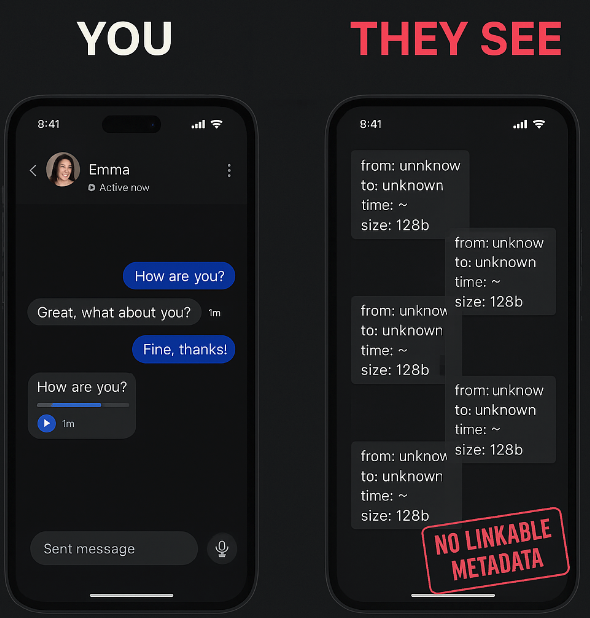
Most messengers encrypt your messages. But they still see who you talk to, how often, when, and for how long. That’s not privacy, it’s metadata surveillance with a prettier face.
Unlink makes metadata unusable, by design.

You apply for a loan. Or a visa. Or insurance. No one reviews it, an algorithm scores your risk.
It doesn’t read your messages. It just sees the patterns: late-night activity, flagged contacts, short exchanges.
You’ve broken no law. But your score drops, and you’re quietly denied.
This isn’t science fiction. It’s already part of how decisions are made, in finance, immigration, and public services.
You don’t need to be guilty to be treated like a risk.
Is this how you expect to be treated, just for sending a message?
You shouldn’t need blind trust to send a message. You shouldn’t have to wonder who’s watching, scoring, or profiling your connections.
Unlink doesn’t just encrypt what you say, it erases what surveillance feeds on. Contact lists never leave your device, and nothing linkable is exposed to the network.
Every message moves through a decentralized network. All traffic looks the same. Identities stay unlinkable, and no one can deny you access.
With Unlink, privacy happens behind the scenes, so seamlessly, you won’t even notice.
Unlike donation-dependent messengers, Unlink sustains itself through the protocol.
A small fee built into each message funds the network, no need for ads, no tracking, no monetization of user behavior.
Half of all users fund the other half through a faucet system, making access universal while keeping abuse out.
Privacy doesn't need a business model, when the protocol funds itself.
Not just encrypted, but unlinkable. Not dependent on trust, but built to make trust unnecessary.
Encryption hides what you say. Metadata shows everything else. Try the messenger that has nothing to leak, by design.
Unlink Messenger isn’t just private by design, it’s reviewed by independent experts, researchers, and open-source contributors around the world.
From security audits to hackathons, its core has been tested, and keeps evolving in the open.
Privacy isn't a feature. It's a standard. And it doesn't depend on trust, only math, review, and transparency.